Touch Sensor: Working Principle, Types, Circuit Design, Applications and Advantages
Overview
Introduction
Touch has become one of the most natural ways for humans to interact with machines. From unlocking a smartphone to operating a microwave oven, the role of touch-based technology is everywhere around us. At the heart of this technology lies a small but powerful component known as the touch sensor.
A touch sensor is designed to detect physical touch, pressure, or the closeness of an object. Once the touch is detected, it converts that action into an electrical signal which can be used to perform a specific task, such as turning on a light, controlling a display, or activating a machine. In this article, we will explore everything about touch sensors in simple and detailed language. You will learn about their working principle, different types, circuit design, practical applications, benefits, and a clear real-world example that explains how they function.What is a Touch Sensor?
A touch sensor is an electronic input device that reacts when someone touches it or brings a finger close to its surface. Unlike mechanical switches that require force to press, touch sensors work without much effort and provide a smooth user experience.
These sensors are widely used in:- Smartphones and tablets
- Household appliances like induction cooktops and washing machines
- Industrial machines with operator panels
- Automotive control systems
- Modern interactive gadgets
Working Principle of Touch Sensor
The basic working of a touch sensor revolves around detecting a small change in capacitance or resistance when a finger comes into contact.
-
Capacitive Working Principle
- Every human body naturally carries an electric charge.
- When a person touches the surface of a capacitive sensor, the capacitance of the circuit changes.
- The sensor detects this change and produces a signal that can be processed by a circuit or microcontroller.
- Capacitive sensors are highly sensitive and commonly used in touchscreens.
-
Resistive Working Principle
- A resistive sensor has two conductive layers separated by a small gap.
- When pressure is applied, the two layers touch each other and the resistance changes.
- This change is detected by the circuit and is used to trigger an action.
- Resistive sensors are less sensitive than capacitive ones but more affordable and durable in harsh environments.
Types of Touch Sensors
1. Capacitive Touch Sensor
- Works by detecting changes in capacitance.
- Very sensitive and supports multi-touch.
- Used in smartphones, tablets, and laptops.
2. Resistive Touch Sensor
- Works by detecting pressure and resistance change.
- More durable against dust and water.
- Used in ATMs, older touchscreens, and industrial control panels.
3. Optical Touch Sensor
- Uses light sources (like LEDs) and detectors to sense touch.
- When a finger interrupts the light path, the sensor detects it.
- Used in kiosks, interactive whiteboards, and large displays.
4. Piezoelectric Touch Sensor
- Works on the piezoelectric effect where applying pressure generates a small voltage.
- Highly durable and suitable for rugged environments.
- Used in industrial systems and some musical instruments.
Touch Sensor Circuit Design
A touch sensor can be made with simple electronic components such as resistors, transistors, and conductive plates.- When you touch the plate, the human body capacitance allows a tiny current to flow.
- This current is enough to activate a transistor, which then switches ON an LED or another output device.
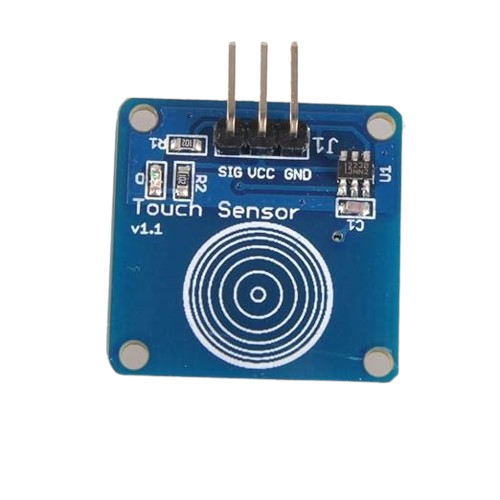
In modern applications, ready-made modules like the TTP223 capacitive touch sensor module are used. These modules provide a digital HIGH or LOW signal when touched, making it easy to integrate with microcontrollers such as Arduino, STM32, or ESP32.
Applications of Touch Sensors
1. Consumer Electronics
- Smartphones, tablets, and laptops rely heavily on capacitive sensors for touch displays and trackpads.
2. Household Appliances
- Microwave ovens, refrigerators, induction stoves, and washing machines use touch-based panels for smooth operation.
3. Automobiles
- Car infotainment systems, steering controls, and smart door handles use touch sensors for advanced user experience.
4. Industrial Uses
- Machines and operator panels in factories use touch sensors for efficient and safe control.
5. Healthcare and Medical Devices
- Touch-enabled devices are used in hospitals and laboratories for accuracy and hygiene.
Advantages of Touch Sensors
-
High Sensitivity: Responds quickly even to a light touch.
-
Durability: No moving mechanical parts, leading to long life span.
-
Compact Design: Ideal for slim and modern devices.
-
User-Friendly: Provides a smooth and modern experience.
-
Multi-Touch Capability: Advanced capacitive sensors can recognize multiple touches at the same time.
-
Resistance to Dust and Moisture: Many models are designed for tough environments.
Example: Using a TTP223 Capacitive Touch Module
To understand better, let’s take an example of a TTP223 touch sensor module.
Circuit Setup:
- Connect the VCC pin to 5V power supply.
- Connect the GND pin to ground.
- Connect the OUT pin to an LED through a resistor.
Working:
- When you touch the sensor pad, the module detects the touch and sends a HIGH signal.
- This turns ON the LED.
- Once you release the touch, the LED turns OFF.
Future of Touch Sensors
Touch sensors are becoming more advanced with time. Today, we see them in gesture recognition systems, foldable displays, and wearable devices. In the future, these sensors may evolve to detect not only touch but also pressure levels, gestures, and even biometric information such as heart rate through skin contact.
Conclusion
Touch sensors have transformed the way humans interact with machines. They provide speed, durability, and convenience compared to traditional mechanical switches. From smartphones to industrial systems, their applications are vast and constantly growing. By understanding their working principle, different types, and practical applications, it becomes clear why touch sensors are considered one of the most important technologies in modern electronics. Whether in a small device like a phone or in large-scale industrial machines, touch sensors will continue to play a major role in creating smarter and more user-friendly systems.Where to Buy
Prices may vary. Click on "Buy Now" to check current availability and pricing.
Administrator
Frequently Asked Questions
Common questions about Touch Sensor: Working Principle, Types, Circuit Design, Applications and Advantages. Find answers to the most frequently asked questions.
User Reviews & Comments
Share your experience with this IoT Blog. Your feedback helps our community make informed decisions!
Share Your Experience
Help others by sharing your thoughts about this IoT Blog.
Related Blogs
Explore more IoT Blogs in the same category
Ultrasonic Sensor HC-SR04 for IoT: Working, Applications, Circuit, and Integration Guide
Sensors
Discover how the Ultrasonic Sensor HC-SR04 works and how to use it in IoT projects. This detailed guide covers its working principle, pin configuration, interfacing with Arduino, applications in smart systems, and complete circuit setup. Ideal for beginners and IoT developers looking to integrate distance sensing in real-time projects.
Vibration Sensor: Working, Types, Applications, and Complete Guide
Sensors
A vibration sensor is a crucial device used to detect and measure vibrations in machines, structures, and environments. This complete guide covers how vibration sensors work, their different types, applications across industries, and factors to consider before selection. Learn how these sensors improve safety, enhance performance, and prevent costly equipment failures.
Best IR Sensor for IoT Projects – Types, Working, Interfacing, and Applications Explained
Sensors
Discover everything about IR sensors used in modern IoT applications. Learn their types, working principles, interfacing methods, and real-world uses. This complete guide helps developers and engineers choose the best IR sensor for smart electronics and automation projects with reliable performance.
No Reviews Yet
Be the first to share your experience with this IoT Blog!